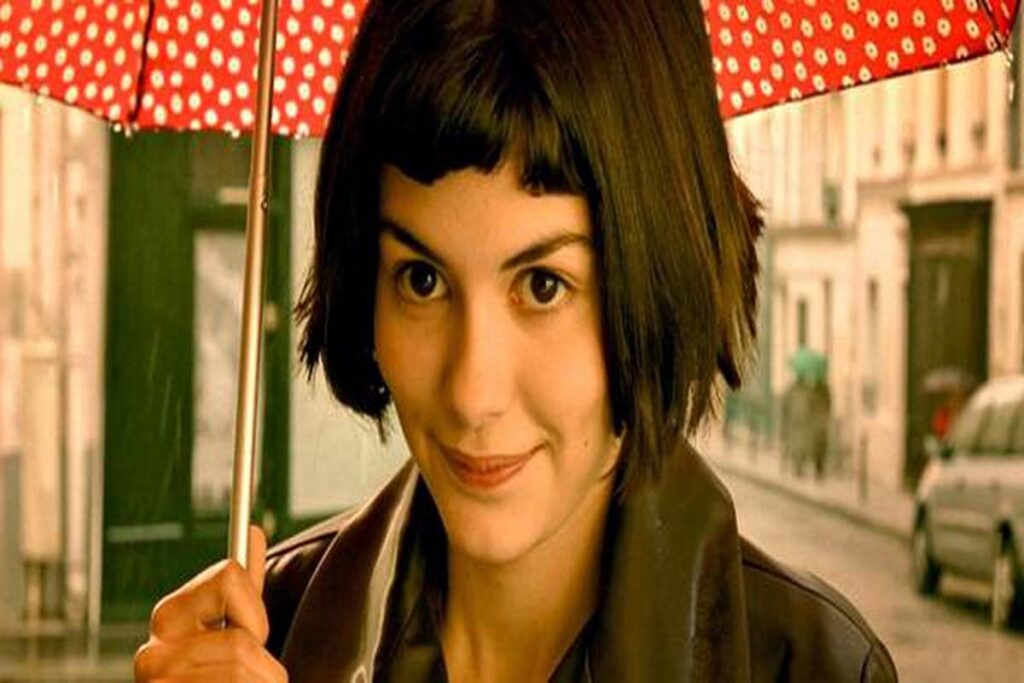
Jean-Pierre Jeunet’s whimsical romantic comedy film Amelie or The Fabulous Destiny of Amelie Poulain is one of the most beautiful films ever made. In Amelie, filmmaker Jeunet creates a fake romanticized Paris which may not be real but colorful, beautiful, charming, amusing, stylish, and overall lovely. A lonely, whimsical waitress named Amelie (Audrey Tautou) returns a man’s childhood memorabilia items, and the sheer joy on his face makes her take a vow to bring happiness to others around her. In the process of making others happy, Amelie falls in love with a man named Nino (Mathieu Kassovitz). After a few hide-and-seeks, she finally gets Nino in her life. Amelie spread waves of positivity not only in France but all over the world. It is not a film to be understood by the brain, but felt through the heart.
Amelie was born in June 1974 in Montmartre, Paris, to idiosyncratic parents who wrongly believe that she has a heart problem, and because of that, they don’t send her to school; instead teach her at home. Loneliness has engulfed her since childhood, and she has developed a whimsical personality. Most of the time, she roams around her fantasy world. Amelie’s sweet little fantasy world gets a big jolt when a Canadian tourist commits suicide by jumping off the Notre-Dame and onto her mother, killing her on the spot. Her father goes into intense depression and isolates himself from social circles. Amelie becomes more and more alienated and finally gets a job as a waitress in Café des 2 Moulines in Montmartre. She spends her free time dipping fingers in grain sacks, breaking the hardened layer of the creme Brulee with a spoon, and skipping stones across Canal Saint-Martin.
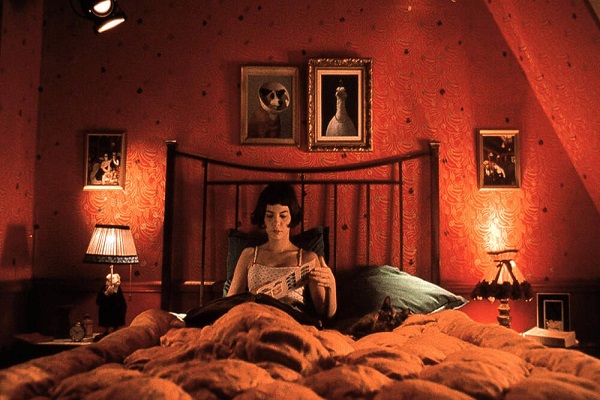
The news bulletin on television regarding Princess Diana’s tragic death in an accident gives her a big shock, and the lid of a perfume bottle falls off her hand. The lid strikes the wall and dislodges a tile. Quite surprisingly, she finds a metal box full of the childhood memorabilia items of a little boy who used to stay in her apartment decades ago. She vows to return the box to its owner, and if it utterly pleases him, she will dedicate her life to bringing happiness to others.
After asking a few old residents of her apartment building, Amelie asks another old resident named Raymond Dufayel (Serge Merlin), a painter who is referred to as “The Glass Man” and replicates French impressionist painter Pierre-Auguste Renoir’s 1881 painting Luncheon of the Boating Party every year, and has been suffering from brittle bone disease. Dufayel is able to recollect the name of the boy, Dominique Bretodeau, who used to stay in her apartment decades ago. Amelie returns the precious box to Bretodeau without being seen or revealing her identity. Countless childhood memories bring tears to Bretodeau’s eyes. This abundance of happiness makes him reconcile with his estranged daughter and meet his grandson. Amelie continues bringing happiness to others.
Amelie helps a blind man to reach the nearest metro station and describes to him the surrounding area while walking swiftly. She inspires her father to fulfil his travelling dreams by stealing his garden-gnome and giving it to her flight attendant friend, who sends her the photographs of the garden-gnome in multiple world-famous landmarks. Amelie helps start the sweet and sour romance between the eccentric cafe regular Joseph (Dominique Pinon) and Georgette (Isabelle Nanty), who works at the cafe and has been suffering from hypochondria. Amelie sends a reconciliatory letter to concierge Madeleine Wallace (Yolande Moreau) in the name of her dead husband, who left her for another woman. Madeleine gets so moved that she pardons her husband and kisses his photograph. Amelie punishes a nasty vegetable shop owner named Collignon, who always humiliates his meek associate named Lucien (Jamel Debbouze) by making his apartment messy.
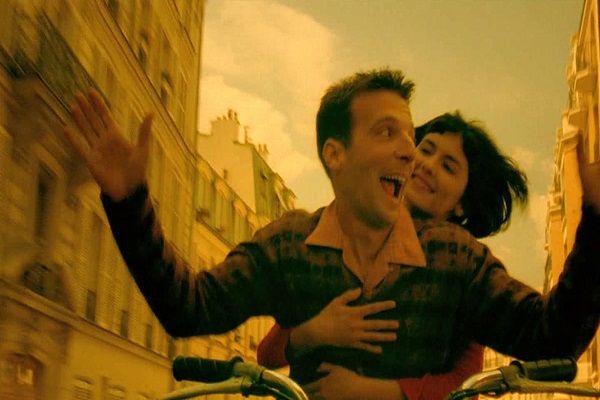
Painter Raymond Dufayel inspires Amelie to pursue an idiosyncratic young man named Nino, who has a bizarre hobby of collecting discarded photographs of strangers from the passport photo booths. Amelie retrieves Nino’s lost folder and then returns it to him after a few hide-and-seek games in and around Paris without revealing her identity. Amelie arranges a meeting with Nino at the cafe where she works, but becomes nervous before the meeting. Dufayel inspires her to propose Nino. Finally, she meets Nino, and they spend a romantic night together. A new romantic journey starts for Amelie.
Amelie comes out of this selfish world and builds her own whimsical fantasy world, where her heart is always filled with the noble intention of doing something good for others. She cannot be described through practicalities and bound within limited boundaries. Her world stretches beyond mere worldly pleasures and happiness. Dedicating her life to others becomes her only motto in life. What we give comes back to us. So, there is no surprise that in the process of finding happiness for others, she finds love for herself. Amelie brings waves of positivity to the entire world. Viewers across the globe can connect to this romantic film, and its popularity increases every day. When the world was mourning the despicable terrorist attack on the World Trade Center, Amelie spread her positivity and romantic fragrances. The world could not help but love her instantly and intensely. The same phenomenon is seen even today, twenty-two years after the film’s release.
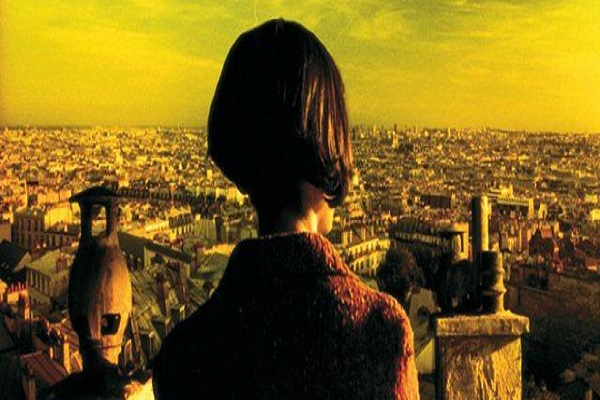
Jean-Pierre Jeunet was always full of imagination and fantasies. When he came to Paris way back in 1974, his notebooks were full of multiple stories mostly inspired by his own life experiences. Even though Amelie is female, she is none other than the female version of Jeunet himself. Releasing the golden fish into Canal Saint-Martin is directly inspired by Jeunet’s own life. Nino, collecting rejected passport photos from the photo booths, is the story of one of Jeunet’s friends. Out of all those stories, a young, whimsical girl bringing happiness to others became the central theme of the film. Opening up one’s personal life to the entire world is never an easy job. So, Jeunet took time before making this deeply personal film. Based on his stories, Guillaume Laurant wrote the screenplay of the film, which is amusing, fantastic, whimsical, and overall romantic. The screenplay provides much information about the characters, their lives, and their choices. Jean-Pierre Jeunet is a very structured and articulate filmmaker. Before the filming even started, he storyboarded the entire film. He does not like to film on location and prefers a completely controlled environment like a studio. However, he filmed in 80 locations across Paris. It was not at all an easy job.
Even though Jean-Pierre Jeunet is a French filmmaker, his films are different from French New Wave films, and they are not based on reality, but on fantasy. In Amelie, he creates a colorful, stylish, fantastic, whimsical, and overall romantic cinematic world where the viewers fall in love with Amelie. They eagerly wait for Amelie’s innocent, sweet, and mischievous endeavors. She spread her fragrance all over the world. The most striking phenomenon of the film is that the viewers in France generally appreciate films rooted in reality, but they instantly fell in love with Jeunet’s version of fake romanticized Paris and its heroine, Amelie.
Initially, filmmaker Jean-Pierre Jeunet wanted to cast Emily Watson to play Amelie. However, her French was not strong enough to play Amelie, and her schedule was booked. So, when she declined the offer, Jeunet got utterly depressed. Audrey Tautou was the first actress to audition for the film, and Jeunet immediately realised that he had found his heroine, and his eyes were filled with tears. Instantly, Audrey Tautou became a darling amongst the cine lovers across the world, and her bob-cut hairstyle became a global hit. The film has an ensemble cast, and all the actors play their characters efficiently and emotionally. All the actors were amusing and a treat to watch on the screen.
Jeunet was much inspired by Brazilian painter Juarez Machado’s extensive use of red, green, and yellow colors in his paintings. So, he used red, green, and yellow color palettes in Amelie. The color palettes were enriched during post-production. The extensive use of lush colors red, green, and yellow, makes Amelie an incredibly colorful, stylish, and beautiful film. It’s a landmark film in the 21st century. The cinematography of the film is so beautiful that each frame looks like a magnificent painting. Cinematographer Bruno Delbonnel used 18 and 25 mm wide-angle lenses to cover the background in detail. The frames look mostly balanced and symmetrical throughout the film. Delbonnel brilliantly captures frames through central framing. The characters are charismatically introduced through zooming in on their faces as if their faces are popping out of the screen. The extensive use of camera movement makes the film super dynamic. Amelie is made up of multiple iconic scenes. Amelie skipping stones across Canal Saint-Martin, retrieving Nino’s photo folder, meeting Raymond Dufayel in his apartment, riding a bike with Nino in the last scene, will be remembered for many, many years. Hervey Schneid’s brilliant editing complements the magnificent cinematography and makes the film super dynamic, fast, and rhythmic.
Filmmaker Jeunet initially wanted Michael Nyman to score the music of Amelie. However, he changed his mind when his production assistant gave him a CD and introduced him to the music composed by Yann Tiersen. Jeunet immediately fell in love with Tiersen’s accordion and piano-based music and asked him to compose the music for Amelie. Within a few weeks, Tiersen scored the soundtrack of Amelie, which also included a few of his existing soundtracks. Music is an integral and very important part of Amelie. When Jeunet submitted the film for the 2001 Cannes Film Festival, festival president Gilles Jacob rejected the film and later cited the reason that the submitted version was a work-in-progress version and without music.
Another important aspect of Amelie is its production design. Filmmaker Jeunet personally likes production design and focuses heavily on that in his films. So, there is no surprise that Amelie has excellent production design. All the pieces of production design, including wallpapers, furniture, and props, are incredibly stylish and beautiful. Amelie was nominated for five Academy Awards at the 74th Academy Awards. It was also nominated for 9 BAFTA Awards, winning two for Best Original Screenplay and Best Production Design at the 55th BAFTA Awards. It was also nominated for Best Foreign Language Film at the 59th Golden Globe Awards.