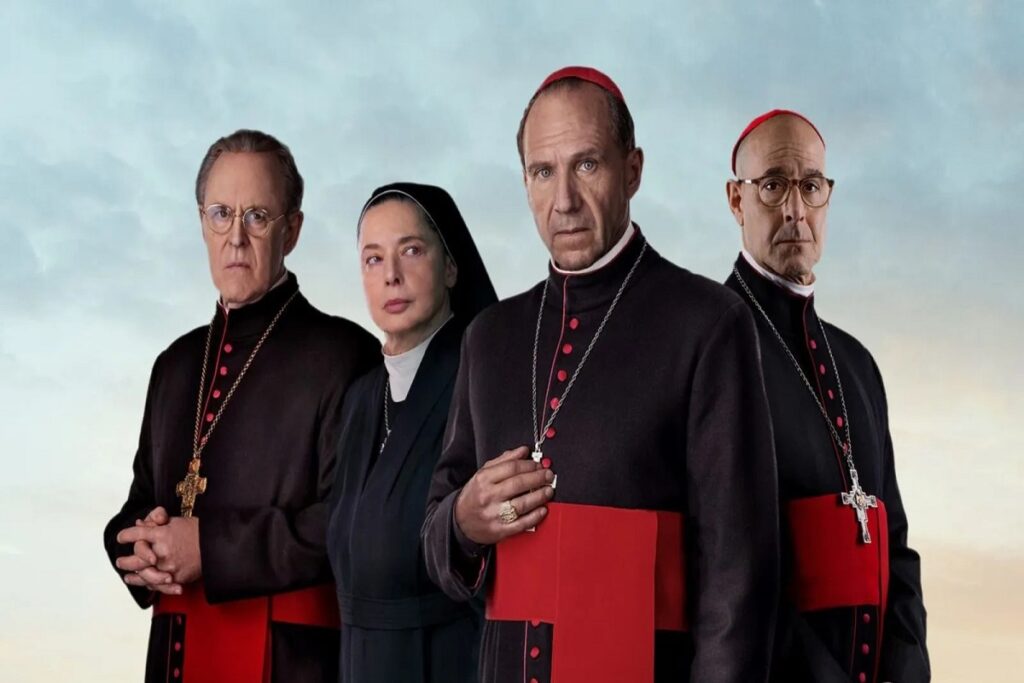
It is not easy to make films linked to a religion. A slight deviance or discrepancy can lead to a major controversy. The followers of the religion worldwide are offended and hurt, which affects the film significantly. However, any religious activities are performed, or any religious organizations are run by ordinary people, not by god. Our beloved Lord is supreme and can’t be questioned. We can only have faith in God. However, people who govern religious organizations can be challenged or doubted based on their past activities. There is nothing wrong with it. In his latest film, Conclave, director Edward Berger shows the internal turmoil and politics of the conclave set up to elect the next pope, when the current pope sadly dies of a heart attack. Berger does not raise any doubt about the existence of Jesus Christ. He only pinpoints the lacunae and flaws of the stalwarts who run the holy Catholic Church and establishes that humans are fallible. They make mistakes irrespective of their organizations, positions, and social status.
The internal politics and power dynamics of the Catholic Church made Edward Berger inquisitive about the inner processes to make a film based on it. Though Berger was born and raised in a Protestant family, he was always fascinated by the rituals and processes of the Catholic Church. When the Pope unfortunately dies of a heart attack, the dean of the College of the Cardinals, Thomas Lawrence (Ralph Fiennes), invites all the cardinals worldwide for a conclave. Although the purpose and task of electing the next Pope may seem straightforward, multiple behind-the-scenes activities make it complex. The power dynamics keep shifting throughout the film. When Cardinal Adeyemi (Lucian Msamati) emerges as the clear winner, his verbal altercation with a Nigerian nun named Shanumi opens Pandora’s box. Cardinal Lawrence discovers that Cardinal Adeyemi has an illegitimate son with that nun. Cardinal Tremblay (John Lithgow) arranged for nun Shanumi’s transfer from Nigeria to the Vatican. When Cardinal Lawrence confronts Cardinal Tremblay, he admits to doing it at the Pope’s request. Cardinal Lawrence breaks the seal of the holy father’s room and finds documents that indicate Cardinal Tremblay bribed other cardinals for votes. When Cardinal Adeyemi and Tremblay are out of the race, Cardinal Lawrence backs progressive Cardinal Bellini (Stanley Tucci) to defeat staunch traditionalist Cardinal Tedesco (Sergio Castellitto). After the College of Cardinals elects Cardinal Benitez (Carlos Diehz) as the new Pope Innocent XIV, Cardinal Lawrence discovers that Cardinal Benitez has a uterus and ovaries, and he had avoided an operation to continue living with his original body. All these activities, secrets, confrontations, and inner turmoils have made Conclave a nail-biting political thriller.
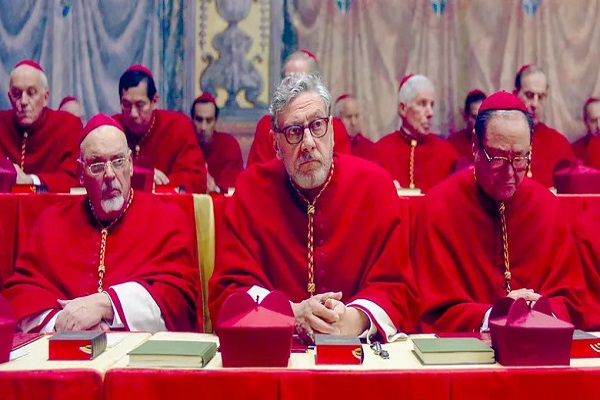
The Catholic Church has been facing multiple accusations for many years. Many priests and bishops have been accused of sexual abuse of women and children. The Catholic Church limits the precious roles of women and does not allow them to be priests or in higher positions. Internal divisions and friction are severe in many places. Often, the Catholic Church is accused of being a stringent, authoritarian, and centralized structure. These phenomena are prevalent worldwide. Director Edward Berger highlights them in Conclave. Cardinal Tremblay bribes fellow cardinals. Cardinal Adeyemi has an illegitimate son with nun Shanumi. The only objective of Cardinal Bellini and Dean Lawrence is to defeat Tedesco. The cardinals are deeply divided among themselves without proper communication with each other. Although director Berger brings the bitter truth of the Catholic Church to the forefront, he never questions the existence of Lord Jesus Christ anywhere in the film. He only holds the mirror for the truth to be reflected in front of the world.
In Conclave, suddenly, Cardinal Adeyemi has a verbal spat with a Nigerian nun named Shanumi. When Cardinal Lawrence interrogates her, she discloses that she has an illegitimate son with Cardinal Adeyemi. When Cardinal Lawrence confronts Cardinal Adeyemi, he confesses to his mistake. He is immediately disqualified to be the supreme leader of the Catholic Church. However, viewers object to why Africans are always portrayed as sexual offenders in movies. There is no denying the fact that many priests and bishops are involved in sexual offenses and scandals worldwide. Director Edward Berger can depict it in the film. But, stereotyping of Africans or African-origin people as sexual offenders in a powerful medium such as films is not acceptable at all.
The most important aspect of Conclave is uncertainty and pluralism. Nothing in this world is absolute and certain. Only God is supreme. Everybody is a different human being. Therefore, there is diversity in opinions, languages, dress, foods, and behavior. The beauty of this world lies in its diversity. Nobody should be forced to adopt something against their will. Therefore, there will be doubts in human minds. Nothing is an absolute truth or principle. Human lives strive for perfection through errors and doubts. If doubts are not tolerated, errors are cursed, and unconventional people are marginalized, this world will remain divided. Minorities and weak people will be cornered and isolated. Happiness and peace will be gone forever.
Another important aspect of Conclave is the depiction of liberation, hope, and optimism. When Cardinal Lawrence looks through the window in the final scene, he sees bright sunshine and jubilant nuns chattering. Director Berger portrays liberation, hope, and optimism through these shots, concluding the film on a positive note. The Holy Sistine Chapel appears claustrophobic with multiple tense moments throughout the film. Therefore, the bright sunshine and jubilant nuns represent a new optimistic beginning. The Catholic Church has survived countless adversaries for many centuries. Still, it has survived and thrived, and it will continue to do the same in the future as well.
Peter Straughan’s adapted screenplay, based on Robert Harris’s 2016 novel of the same name, chronicles the drama and power dynamics of the papal election within the Catholic Church. Director Berger masterfully converts the political drama into an incredible political thriller, without hurting the religious sentiments. The ensemble cast delivers outstanding performances in the film. The self-doubt and inner turmoil of Cardinal Lawrence are vividly portrayed in Ralph Fiennes’s facial expressions and piercing eyes throughout the film. Fiennes’s portrayal of Cardinal Lawrence has received worldwide critical acclaim. In the small but significant character of sister Agnes, Isabella Rossellini delivers an outstanding performance. Stanley Tucci as Cardinal Bellini and John Lithgow as Cardinal Tremblay justify their characters. In his first screen performance, Carlos Diehz stands out as Cardinal Benitez.
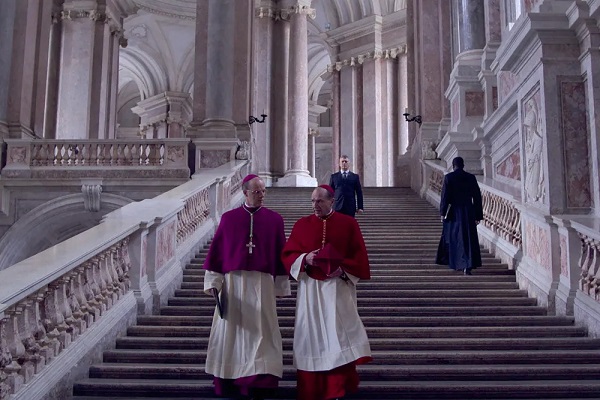
Another major aspect of Conclave is Stephane Fontaine’s magnificent cinematography. His camera has created a suspenseful and claustrophobic look for the film, utilizing the 2.40:1 aspect ratio. Fontaine’s camera has meticulously captured the inner turmoil of the cardinals in multiple close-ups, especially the piercing eyes of Ralph Fiennes as Cardinal Lawrence. Fontaine’s camera is mostly static in interior scenes; however, it follows and keenly observes the characters in the corridor, as well as in exterior scenes. Cinematographer Fontaine has incredibly utilized contrasting colors throughout the film. Red-robed cardinals sit in the conclave amid darkness. The bright dresses of the cardinals are set against the backdrop of the architecture’s saturated colors, creating a striking contrast. Conclave features multiple incredible shots. One iconic shot is when the cardinals walk in with white umbrellas.
Though Conclave revolves around the papal election process, the focus of the film is not on religion but on politics, suspense, and thrills. Therefore, composer Volker Bertelmann’s music is not overtly religious, but claustrophobic and thrilling, which he achieved by using the 1952 rare musical instrument named Cristal Baschet. Composers rub the glass rods of the Cristal Baschet with wet fingers to create a distorted synesthetizer-like tune.
Another major achievement of Conclave is Suzie Davies’s production design. As it was not possible to film in the actual Sistine Chapel and Casa Santa Marta, director Edward Berger obtained artistic license to build them in studios. Also, the real Casa Santa Marta was not cinematic enough to create a thrilling and suspenseful cinematic environment. Suzie and her team of 25 members built the sets over a period of six months in Rome’s famous Cinecittà studios with a digital extension on top to recreate the famous frescoes made during the Italian Renaissance. The claustrophobic set has incredibly complemented the bright red colored costumes.
Lisy Christl’s costume stands out throughout the film. She also received artistic license to make certain changes to the original cardinal costumes. The robes of the cardinals were made, and not rented. Lisy chose crimson over scarlet as the color of the robes, as crimson is more pleasing to the camera. The accessories of the cardinals were customized as per their ideologies. She chose a silver cross for the liberal Cardinal Lawrence, but a gold Cross for traditionalist Cardinal Tedesco.