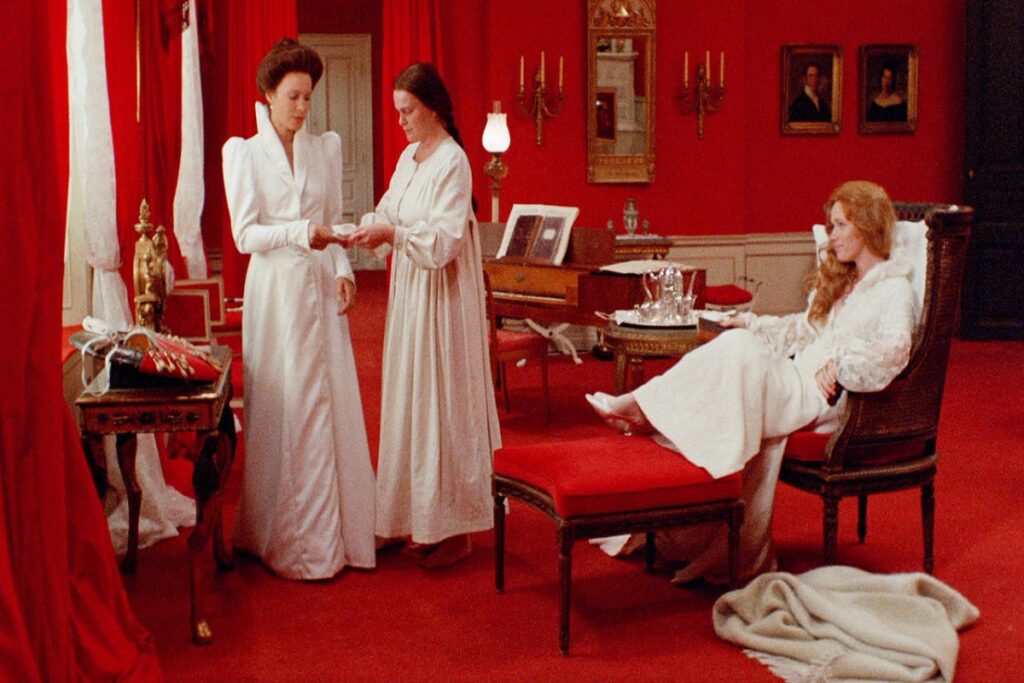
Ingmar Bergman explored profound female psychology and relationship dynamics in Cries and Whispers. His exploration reached the furthest limits of cinema as a visual medium. Bergman said Cries and Whispers was always one of his favorite films. The film focuses on three sisters and a housemaid living in a manor in the late 19th century. The eldest sister (Harriet Andersson) has been suffering from terminal uterine cancer. The other two sisters come to the manor to check on her health; however, they fail to bond emotionally. The housemaid looks after the oldest sister lovingly, and they form a deep emotional bond. In Cries and Whispers, Ingmar Bergman explored social isolation, alienation, mortality, physical decay, emotional turmoil, sibling rivalry, ego, love, faith, and redemption.
Mortality and physical decay are the central themes of Ingmar Bergman’s Cries and Whispers. Death is a brutal reality and cannot be avoided. Artistic mediums, including cinema, have frequently romanticized death. However, Bergman takes the other path and shows the painful process of physical decay and death. He highlights the enormous suffering before death. In Cries and Whispers, Agnes has been suffering from terminal uterine cancer for the past twelve years. The ticking clock constantly reminds viewers of her fragile mortality. Bergman always imagined the soul in red. So, he chose a crimson-colored interior, including walls, carpets, and curtains in the film. Agnes’s enormous suffering and subsequent death amid the crimson-colored interior of the manor show the proximity of life and death. During this pivotal juncture, humans are unmasked, and the truth comes out. Agnes’s biological sisters visit her to check on her health, but fail to comfort and support her emotionally. But housemaid Anna (Kari Sylwan) forms a deep emotional bond with her, warms her with physical touch, and cradles her like Pietà.
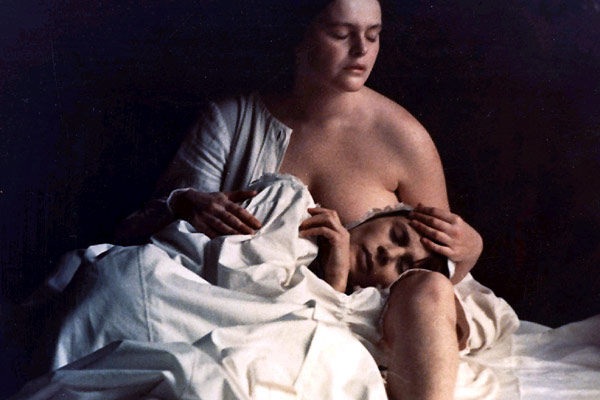
Emotional turmoil, agony, and suffering are the major themes of Bergman’s films. Cries and Whispers is not an exception. Agnes has been suffering from uterine cancer for the past twelve years. Her physical decay and prolonged suffering are felt through her intense screams. However, her isolation and alienation because of her emotionally cold and repulsive sisters also agonize her mentally. She yearns for their presence but cannot find solace even when they are around. Only housemaid Anna offers her true care, love, comfort, consolation, and solace. Maria (Liv Ullmann) is an emotionally hollow, spiritually void, self-absorbed, attention-seeking, and repulsive woman. She has an extramarital affair with doctor David and often seeks his attention. Agnes’s immense physical torment and her husband Joachim’s suicide attempt repel her, instead of providing them with emotional support and consolation. Karin (Ingrid Thulin) is emotionally distant from her sisters and husband. She suffers from resentment and self-loathing. She is dissatisfied with her marital life, cuts her genitals with a broken piece of wine glass, and smears blood on her face to repel her husband. The housemaid Anna suffers from deep psychological trauma after losing her three-year-old daughter because of Doctor David’s negligence. Her suppressed maternal devotion makes her cradle Agnes like the Pietà. She is the only person who provides Agnes with emotional support, love, care, and comfort through physical touch.
In Cries and Whispers, Ingmar Bergman brilliantly portrays siblings’ rivalry and ego. Siblings play an important part in our lives. Their shared memories bond them, making them pillars of strength for each other in times of crisis. They shared a nearly identical childhood, and their bond grows stronger with each passing day. However, the quality of life severely deteriorates when siblings turn into rivals. In Cries of Whispers, three sisters, Agnes, Karin, and Maria, fail to bond emotionally. Karin and Maria’s presence in the manor does not console or comfort Agnes. Rather than providing Agnes with true love and emotional sanctuary, Karin and Maria hide behind a facade of pretentious affection. Agnes’s terminal illness repels them. Their mother loved Maria more and paid her more attention. Sometimes, she even teased Agnes when she needed her most. Neglected children suffer from resentment, alienation, and existential crisis. These three sisters have been carrying emotional baggage and bitterness toward each other since childhood. Lifelong bitterness and rivalry have made them emotionally distant.
A major theme of Bergman’s Cries and Whispers is the importance of human touch and connection. He draws a parallel to the Christian art concept of the Pietà. In the Pietà, Mother Mary laments the death of Lord Jesus Christ and cradles his dead body after crucifixion. In the film, housemaid Anna cradles Agnes before and after her tragic and agonized death. Anna holds Agnes against her bare body to offer affection, love, care, consolation, warmth, and comfort. When Agnes’s terminal illness repels her own sisters, instead of invoking emotional support and attachment, housemaid Anna cradles her to offer all the care and support during the most difficult phase of her life. In Cries and Whispers, Bergman vividly shows that redemption and heaven can only be achieved through real human connections irrespective of formal relationships.
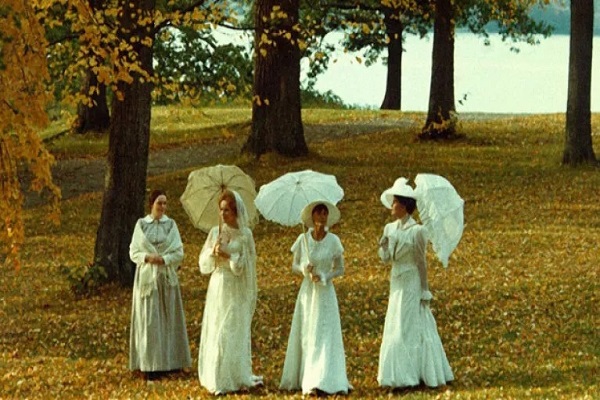
Ingmar Bergman himself wrote the screenplay for Cries and Whispers and avoided conventional dialogue. Memories are invoked through multiple flashbacks. He envisioned several women dressed in white in a crimson-walled room. He also imagined the soul in red, filled with blood vessels and covered by a membrane. As a result, he directed the film mostly through visuals rather than through traditional dialogue. In Cries and Whispers, four actors, Harriet Andersson as Agnes, Ingrid Thulin as Karin, Liv Ullmann as Maria, and Kari Sylwan as Anna, delivered powerful performances. Instead of relying on heavy dialogue, they played their characters with incredible rawness, viscerality, silence, body language, facial expressions, and vocal nuance. Harriet Andersson outstandingly portrayed Agnes, an alienated, terminally ill, dying character. Ingrid Thulin brilliantly portrayed Karin’s disgust, repression, rigidity, and self-loathing. Liv Ullman depicted Maria with superficiality, revulsion, narcissism, and emotional detachment. Karie Sylwan’s outstanding depiction of Anna, the only person who offers Agnes true care, Affection, love, warmth, comfort, and consolation during the most trying time of her life, is one of the most important aspects of Cries and Whispers.
A major aspect of Cries and Whispers is Sven Nykvist’s cinematography. His camera captured the characters’ suffering, agony, alienation, isolation, emotional turmoil, loathing, repression, rigidity, emotional detachment, yearning, love, care, affection, and consolation through piercing close-ups amid the claustrophobic setting. He filmed the exterior scenes in natural light and the interior scenes with soft, diffused, and radiant light. Nykvist eschewed traditional, high-contrast Hollywood glamour lighting to ensure that the visuals felt organic rather than artificially illuminated.
Ingmar Bergman imagined the interior of the human soul in deep red, filled with blood vessels, and covered by a membrane. He also dreamed of several women dressed in white gowns in a crimson-walled hall. His imagination triggered the concept of Cries and Whispers. Production and costume designer Marik Vos transformed Bergman’s imagination into reality. The film was shot in Sweden’s Taxinge-Näsby castle. Marik Vos had the castle rooms repaired, redecorated, and repainted. The walls, carpets, and furniture were painted crimson. Marik Vos designed the beautiful aristocratic women’s dresses in white and black. The white gowns represent purity and sickness, and the black gowns symbolize death and mourning.