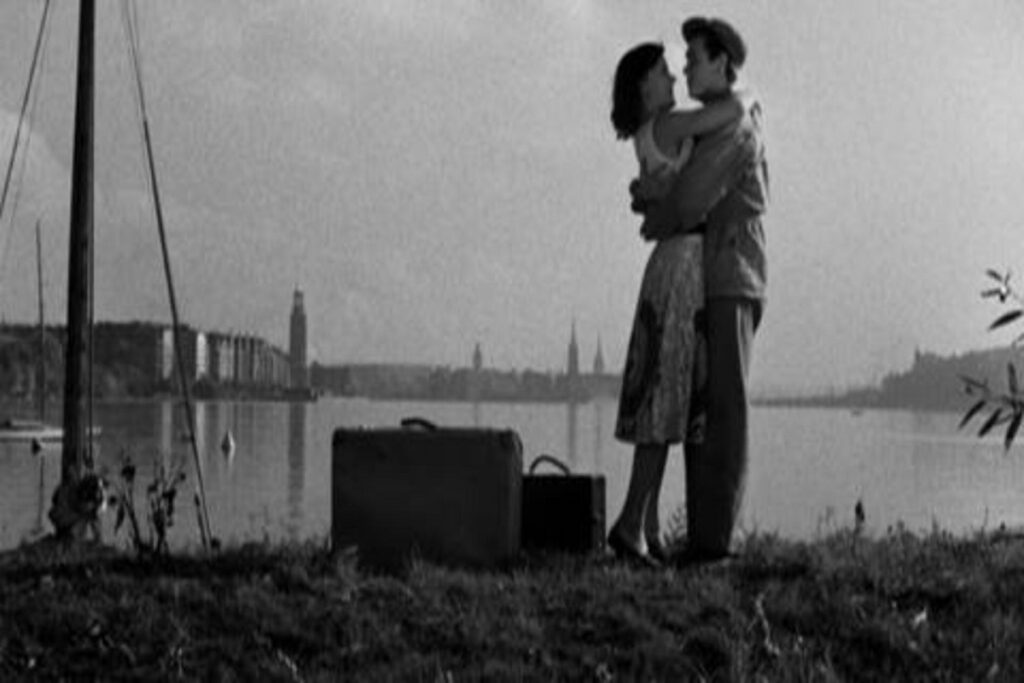
Ingmar Bergman’s Summer with Monika is one of the most heartbreaking romantic films ever. Two working-class teenagers, Harry (Lars Ekborg) and Monika (Harriet Andersson), happen to meet in a cafe and subsequently fall in love. They escape the mundane daily life by quitting jobs and running away to the Stockholm Archipelago. There, they spend the summer together, and Monika gets pregnant. After they return to the city, they are blessed with a baby girl, and Harry desperately tries to settle down and take responsibility for his family. However, Monika loses interest in family life and leaves. The blissful life they dreamed together while spending the summer is shattered. The most crucial question remains why Monika abandons her newborn daughter and a dedicated husband.
The most important question in Summer with Monika is why Monika abandons her newborn daughter and husband. She spends a romantic summer in the serene Stockholm Archipelago, has a loving, caring, and responsible partner who tries very hard to settle down and make ends meet, and is blessed with a baby girl. She has all that she yearned for before the summer sojourn. But she leaves everything, even her newborn daughter. However, she cannot be vilified bluntly. Viewers need to understand the socioeconomic conditions in which she was born and brought up. She was born and brought up in a low-income family with multiple younger siblings. Her father is a drunkard, struggles to run the family, and frequently assaults her physically. She is sexually assaulted even in her workplace. It is quite obvious that her tolerance limit has been reduced significantly. She can no longer get accustomed to the minuscule hurdles of daily life. So, she cannot tolerate Harry’s absence, and the rearing of her newborn daughter appears to be a burden. Sometimes, circumstances alter our personalities and force us to take the wrong path. We become so vulnerable and helpless that we can’t turn back.
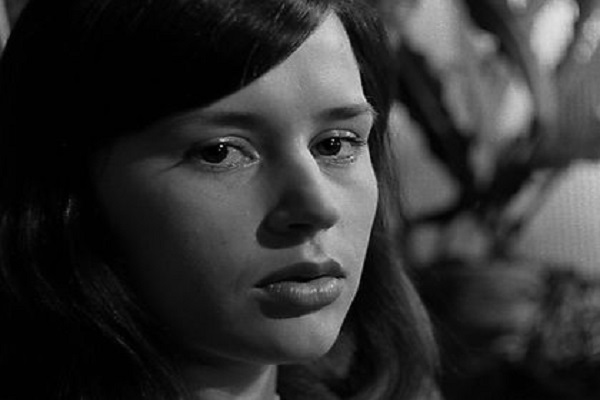
The life of an artist is reflected in their art. In Summer with Monika, Bergman’s own life is reflected in Monika’s character. Neither Bergman nor Monika was happy and satisfied with their upbringing. Bergman’s father was a Lutheran minister. So, he was brought up in a strict Lutheran household. Even though he loved his mother, he shared a strained relationship with his father, which led to his ouster from his paternal home at the age of nineteen. He married five times and also had multiple partners, which made his personal life unstable. Monika is tormented both at home and work. Her father assaults her physically, and her work colleague assaults her sexually. So, she becomes restless, vulnerable, and whimsical, much like young Bergman.
Summer with Monika has very little Nudity and a very few erotic scenes. However, it created immense hue and cry in those days for its erotic scenes. If the film is released now, it will surely not generate such negative publicity for its content. An American distributor acquired the distribution rights to the film and released it in the US countryside under the title Monika, the Story of a Bad Girl. This is an example of how an art piece is financially exploited, causing significant damage to its artistic value. However, the original version was released later in the USA, which restored its glory.
Bergman’s Summer with Monika is deeply inspired by Italian neorealism. It has the characteristics of Italian neorealistic films, like shooting on location, low budget, non-professional actors, and stories about working-class people and their daily lives. Though Harriet Andersson and Lars Ekborg were not fully non-professional actors, they were comparatively new to the acting arena. Both Monica and Harry were born and raised in lower-middle-class households, and the film tells the story of their daily lives, dreams and aspirations, romance, and eventual separation. The film was mostly shot on location, mainly on the island of Orno in the Stockholm Archipelago. Some scenes were filmed in Stockholm itself. Summer with Monika was also a very low-budget production.
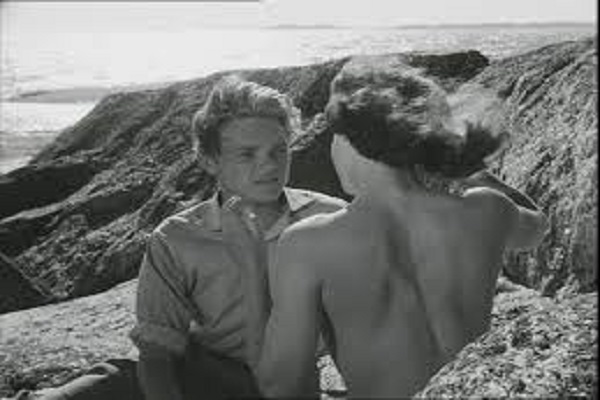
Bergman used his signature styles, including long takes and piercing close-ups, in the film. The close-up shot, in which Monika lights a cigarette with her old lover Lelle, and then the background turns black, is an outstanding close-up shot that inspired the closing shots of the French New Wave films – Breathless, directed by Godard, and The 400 Blows, directed by Truffaut. Summer with Monika is enriched by Gunnar Fischer’s magnificent black-and-white cinematography, especially the scenes filmed in the Stockholm Archipelago. Erik Nordgren and Les Baxter’s orchestral music complements Monika and Harry’s romance and then turns melancholy during their separation.
Ingmar Bergman had a romantic relationship with Harriet Andersson, which started in 1952 at Malmö Theater Company, where Bergman was the director, during the filming of Summer with Monika. This film was Bergman’s love letter to Harriet. They continued to work further on Sawdust and Tinsel and Smiles of a Summer Night. Even though their affair ended in 1955, they continued to collaborate further on Through a Glass Darkly and Cries and Whispers. In 1992, Bergman referred to Harriet Andersson as one of the finest actors in the world.